
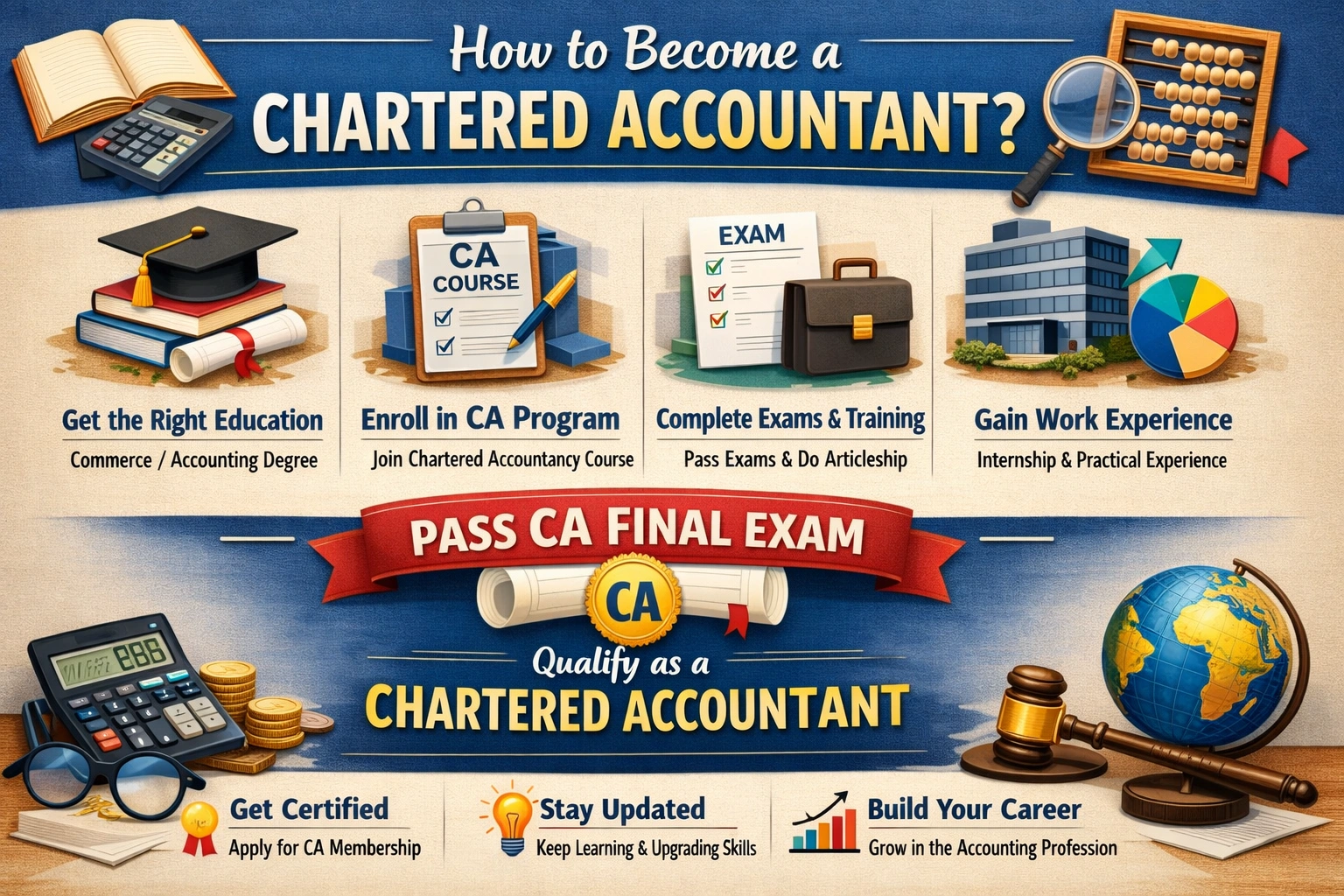
Becoming a Chartered Accountant (CA) is a prestigious and rewarding career choice for students who are interested in finance, accounting, taxation, and business law. Chartered Accountants are highly respected professionals who play a crucial role in auditing, financial management, and strategic decision-making for businesses and individuals. In this comprehensive guide, we will explain how to become a Chartered Accountant, eligibility criteria, course structure, exams, training, skills required, and career opportunities.
What Is a Chartered Accountant?
A Chartered Accountant is a qualified financial professional certified by a recognized accounting body. In many countries, including India, the CA qualification is regulated by a professional institute. CAs are experts in accounting, auditing, taxation, financial reporting, corporate laws, and advisory services. They work with corporations, government bodies, startups, and multinational companies, or run their own professional practice.
Eligibility to Become a Chartered Accountant
Students can start the Chartered Accountancy course right after completing Class 12 or after graduation.
After Class 12 (Commerce or Non-Commerce):
- Pass Class 12 from a recognized board
- Students from commerce, science, or arts streams are eligible
After Graduation or Post-Graduation:
- Commerce graduates need a minimum percentage in relevant subjects
- Non-commerce graduates may require a slightly higher percentage
- Graduates can enter directly into intermediate-level studies
Step-by-Step Process to Become a Chartered Accountant
Step 1: Register for the Foundation Level
The Foundation level is the entry point for students who enroll after Class 12. It focuses on basic concepts of accounting, business laws, mathematics, and economics. This level builds a strong foundation for advanced studies.
Subjects generally include:
- Principles of Accounting
- Business Laws
- Quantitative Aptitude
- Business Economics
Students must clear all subjects to move to the next stage.
Step 2: Clear the Intermediate Level
The Intermediate level is more advanced and divided into two groups. It covers in-depth topics related to accounting, taxation, auditing, and financial management.
Key subjects include:
- Advanced Accounting
- Corporate and Other Laws
- Cost and Management Accounting
- Taxation
- Auditing and Assurance
- Financial Management
Students can attempt one group at a time or both groups together.
Step 3: Complete Practical Training (Articleship)
Articleship is a mandatory practical training period that provides real-world experience. During this time, students work under a practicing Chartered Accountant and gain hands-on exposure to auditing, taxation, compliance, and accounting.
This training helps students understand professional ethics, client handling, and practical application of theoretical knowledge.
Step 4: Appear for the Final Level
The Final level is the last and most challenging stage of the CA course. It focuses on advanced professional knowledge and practical problem-solving skills.
Subjects may include:
- Financial Reporting
- Strategic Financial Management
- Advanced Auditing
- Direct and Indirect Tax Laws
- Corporate and Economic Laws
Passing this level demonstrates a student’s readiness to work as a professional Chartered Accountant.
Step 5: Become a Certified Chartered Accountant
After successfully clearing all levels and completing practical training, candidates can apply for membership. Once approved, they are officially recognized as Chartered Accountants and can use the “CA” title before their name.
Skills Required to Become a Successful Chartered Accountant
To excel as a Chartered Accountant, students should develop the following skills:
- Strong analytical and problem-solving abilities
- Attention to detail and accuracy
- Good communication and presentation skills
- Time management and discipline
- Ethical judgment and professional integrity
- Continuous learning mindset
Career Opportunities After Becoming a Chartered Accountant
Chartered Accountants enjoy diverse career options across industries, such as:
- Auditing and Assurance
- Tax Consultancy and Planning
- Corporate Finance and Investment Banking
- Financial Analysis and Risk Management
- Government Services and Regulatory Bodies
- Entrepreneurship and Private Practice
CAs are in demand globally, and the qualification offers excellent growth, job stability, and earning potential.
Conclusion
Becoming a Chartered Accountant requires dedication, discipline, and perseverance, but the rewards are significant. It is a career that offers professional respect, financial security, and opportunities across multiple sectors. With a clear understanding of the process, proper planning, and consistent effort, aspiring students can successfully achieve their goal of becoming a Chartered Accountant and build a bright future in the world of finance.