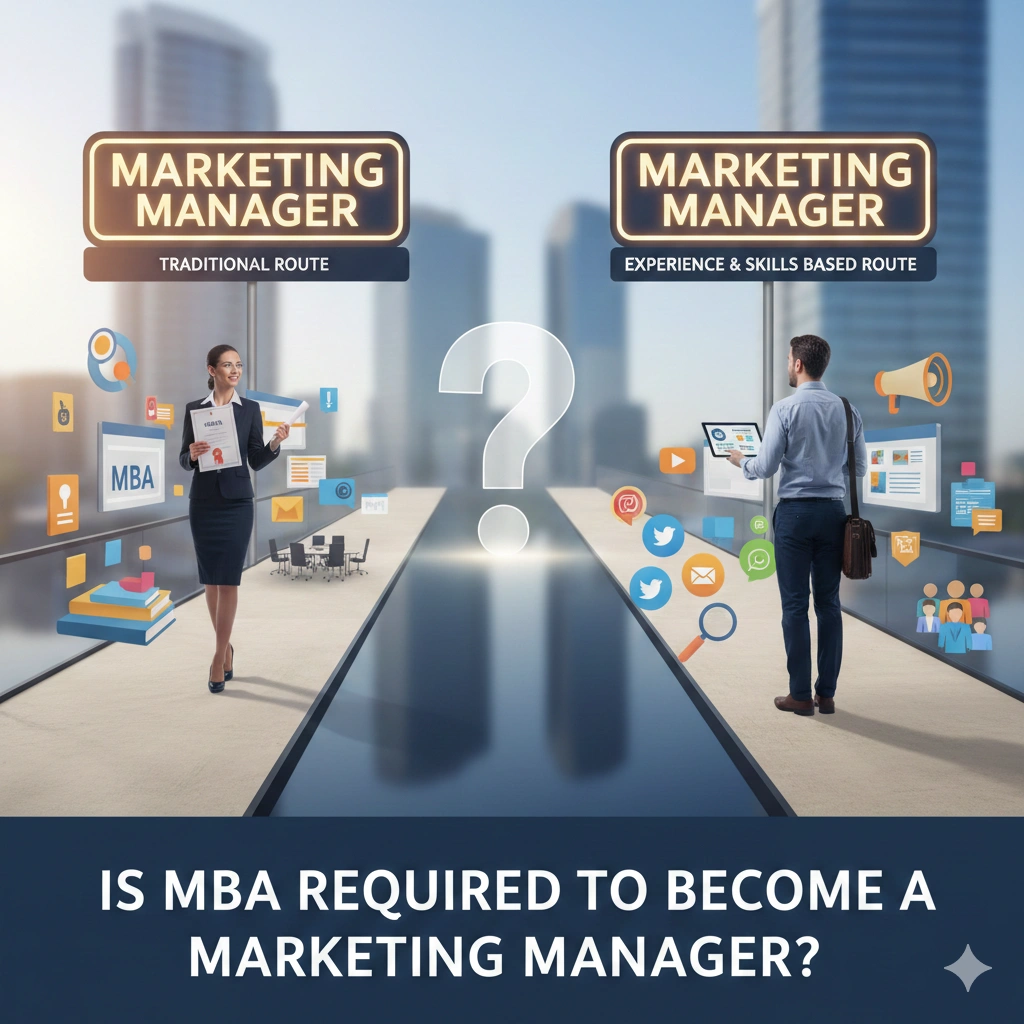
In today’s competitive business environment, the role of a Marketing Manager has become one of the most sought-after career paths. Marketing managers are responsible for building brand strategies, analyzing market trends, managing campaigns, and driving business growth. A common question among students and professionals is: Is an MBA required to become a Marketing Manager? The short answer is no—but having one can certainly help. Let’s explore this in detail.
Understanding the Role of a Marketing Manager
A Marketing Manager oversees marketing strategies that promote products or services. This includes market research, digital and traditional advertising, content planning, brand positioning, budgeting, and team coordination. The role requires a mix of creativity, analytical thinking, communication skills, and leadership ability. Because of these diverse responsibilities, there is no single mandatory educational path to reach this position.
Is an MBA Mandatory?
An MBA (Master of Business Administration), especially with a specialization in Marketing, is not mandatory to become a Marketing Manager. Many successful marketing managers have built their careers without an MBA. Companies often prioritize skills, experience, and performance over formal degrees. If you can demonstrate strong marketing results, strategic thinking, and leadership capabilities, you can progress into a managerial role without an MBA.
However, in some large corporations or multinational companies, an MBA may be preferred—particularly for senior-level or global roles. Preference, though, does not mean requirement.
Advantages of Having an MBA in Marketing
While not required, an MBA can provide several advantages:
- Structured Business Knowledge
An MBA offers in-depth exposure to marketing strategy, consumer behavior, finance, operations, and management. This holistic understanding of business can be valuable in decision-making roles. - Career Acceleration
For fresh graduates or professionals looking to switch careers, an MBA can fast-track entry into managerial positions. - Networking Opportunities
Business schools provide access to alumni networks, industry experts, and recruiters, which can open doors to better job opportunities. - Credibility
An MBA degree can enhance your professional credibility, especially in competitive job markets.
Alternative Paths Without an MBA
If you don’t have or don’t want to pursue an MBA, there are multiple alternative routes to becoming a Marketing Manager:
- Bachelor’s Degree + Experience
A degree in marketing, business, communications, or a related field combined with hands-on experience can be enough. Many professionals start as marketing executives, coordinators, or analysts and grow into managerial roles. - Digital Marketing Skills
In the modern era, skills in SEO, social media marketing, content marketing, performance advertising, email marketing, and marketing analytics are highly valued. Proven success in digital campaigns can outweigh formal qualifications. - Professional Certifications
Certifications in digital marketing, brand management, analytics, or product marketing can strengthen your profile and demonstrate expertise. - Strong Portfolio and Results
Employers often care more about measurable outcomes—such as revenue growth, lead generation, or brand engagement—than degrees. A strong portfolio can be a powerful asset.
What Employers Really Look For
To become a Marketing Manager, employers typically focus on:
- Strategic thinking and planning ability
- Leadership and team management skills
- Data-driven decision-making
- Communication and presentation skills
- Understanding of consumer behavior
- Ability to execute successful campaigns
An MBA can help develop these skills, but they can also be acquired through experience, self-learning, and continuous professional development.
MBA vs. Experience: Which Is Better?
There is no universal answer. An MBA is beneficial if you aim for corporate leadership roles, international exposure, or structured learning. On the other hand, practical experience is often more valuable in fast-changing fields like digital marketing. Many organizations prefer candidates with real-world results over academic qualifications.
Final Verdict
An MBA is not required to become a Marketing Manager, but it can be an advantage depending on your career goals, industry, and organization. If you have strong marketing skills, relevant experience, and a proven track record, you can reach a marketing management position without an MBA. Ultimately, success in marketing depends more on skills, adaptability, creativity, and performance than on a single degree.